
It’s been years, and it seems like enterprise teams are still getting the same advice: add another tool. Add another dashboard. Why not add another layer of protection while you’re at it? Maybe the environment is looking stronger on paper, but the work difficulty keeps increasing.
That gap between theory and reality is no longer a side issue. It shapes how fast teams respond, the way they detect risk, and how much time they lose keeping the stack solid.
If your team has to leapfrog across ten different screens to handle basic tasks like performance reviews, alert monitoring, ticket tracking or policy management, then control is already slipping out of your hands like sand. You’re not getting faster; you’re getting friction. Work slows and handoffs multiply. Too much time gets spent managing systems instead of helping the business move forward.
That’s the real cost of complexity.
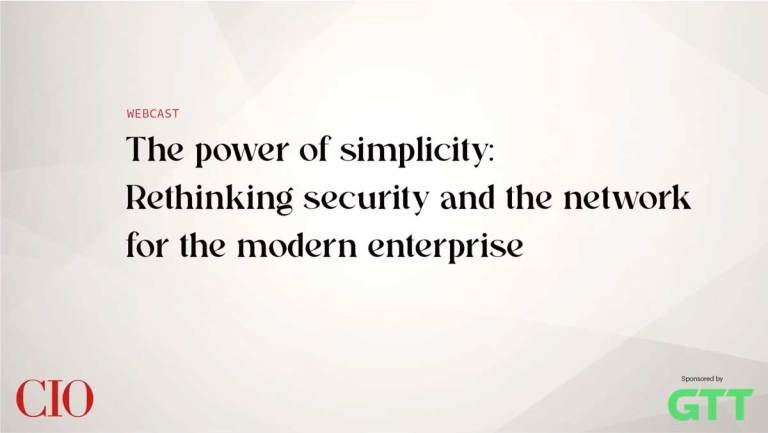
And it’s a major theme that was clearly noted in GTT’s recent Foundry webinar. Simplicity is not a cosmetic upgrade. It’s an operating choice that affects security, performance and if your whole organization is prepped for what AI will demand next.
More tools don’t add up to more clarity
For most teams, bad judgment isn’t what created their sprawling environments. They bought point solutions to solve real problems, like a firewall for one and a VPN for another. CASB, MDR, SD-WAN, separate monitoring tools and separate workflows. Each purchase was purposeful. The trouble arrives later, when all of those decisions are being forced to work together in ways they’re simply not designed to.
That’s when you start to see the cracks showing. Network teams get one version of events while security teams review another. Meanwhile the service desk works from somewhere else. Then when leadership asks a simple question about exposure, spend or performance, getting a helpful answer just takes too long.
In the webinar, Tom Major shared a customer view that cuts through the usual noise. If a team already has ten systems, they don’t want an eleventh. Instead, they want fewer tools that require less training overhead, leading to a simpler way to understand operational context.
To reemphasize this reality: More technology does not always bring better control. On the contrary, it often brings more maintenance, overlap and management gaps.
Let’s not forget the human cost either. Alert fatigue wears everybody down, as does the constant demand to learn one more platform interface or way of working. Complexity hurts efficiency while draining critical attention and judgment resources.
Network and security no longer sit in separate lanes
For the most part, networking and security have been treated as distinct disciplines with different owners and different concerns. That split is making less sense now.
Network data and security data are more often influencing the same decision trees. Teams respond to the same performance issues, the same policy questions and the same pressure to move faster without losing control. This structural divide is already fading for many organizations, so that what once sat in separate groups now sits under one broader function.
That helps explain the interest in SASE and SSE (though the acronym is less important than the operating model behind it). Teams are looking for fewer silos and better visibility, supporting faster decision-making and less time wasted figuring out who owns the problem.
Buyers certainly don’t need another flood of buzzwords. Rather, they need a cleaner way to run the environment, cutting through the clutter without surrendering security or performance. That’s a more useful conversation (and a more honest one, let’s admit).
Better decisions start with a shared view
One practical element to clarify is that of shared data. No, not more data, but better access to the data that actually matters. That distinction is worth holding onto.
A company won’t solve fragmentation by sticking a fresh platform on top of old fragmentation. If users still are required to hop between disconnected systems, the problem lingers (and will eventually start to smell). You need a clearer operational view that brings together the relevant information and presents it in a way that aligns with the workflow.
That’s why digital experience is more than a design question. When customers, partners and internal teams work from the same core data, response speeds up. Root cause is easier to target and conversations get more efficient and effective.
Let’s not overlook the fact that too many enterprise tools still reflect provider logic instead of customer logic. They mirror how vendors organize services, not how teams solve problems. That mismatch creates drag. A better experience starts with the site, the endpoint, the service issue or the business problem, rather than the vendor’s internal structure.
AI raises the standard
AI has changed the tone of infrastructure planning. It has also exposed weak operating models faster than many teams expected. Much of the public conversation around AI still stays at a high level while enterprise leaders are dealing with more concrete issues. Where should workloads run? How close should inference sit to users or sites? How do you handle governance across regions?
Don’t take these as abstract questions. They will directly affect network design, security policy, visibility and performance.
AI demand has moved faster than traditional planning cycles. Teams used to working on multi-year infrastructure rhythms must adapt much faster, leaving little room for messy operating environments. When the facts are scattered across too many systems, decision-making slows at exactly the wrong moment.
Simplicity belongs in this conversation for a reason.
You can’t scale AI on top of confusion. You can’t make viable decisions about edge, cloud, latency or data handling when no one has a clear view of the environment. New workflows are hard enough. They don’t need the added burden of five systems, three teams and a bunch of conflicting signals.
Before AI becomes a value story, it must be an operating story. The companies that handle it well will be the ones with cleaner visibility, tighter coordination and fewer barriers between signal and action.
The physical side still counts
Complexity is not only a software problem. It shows up onsite too.
Branches and distributed offices don’t have endless space, endless or patience for complicated infrastructure. Teams want fewer devices and lower support overhead. The last thing they need are environments that demand constant attention just to stay functional.
Simplicity affects a company’s footprint, staffing pressure, operating cost and resilience. You want immediate benefits? Then replace layers of disconnected gear and management burden with a more unified setup. You’ll see it in daily operations as the environment becomes easier to support and easier to adapt when priorities change.
What leaders should ask now
Still, many enterprise teams are starting in the wrong place by asking what to add next. The better question is what’s creating the drag, so you can remove it and consolidate.
- Where do teams still switch systems to answer basic questions?
- Where are network and security views still separated in ways that slow response?
- Which tools require more administration than deliver insight?
- How quickly can your teams understand what’s happening at a location, across an application path or inside a service issue?
- Does your AI strategy rest on clear operational facts or on assumptions stitched together from disconnected sources?
Instead of just a feature checklist, these questions point to the main underlying issue. Enterprise environments don’t really need more layers; they need fewer obstacles.
As noted in the webinar, the next phase of networking and security won’t reward companies for piling on more tools. It’ll favor the ones that reduce friction, align teams around a clearer view of the environment and build operations that hold up under pressure.
Simplicity is often treated as a softer idea, almost cosmetic, but it’s nothing of the sort. It affects speed, control, cost and readiness for what’s just around the corner. It gives skilled teams a better chance to do strong work and helps leaders make cleaner decisions. It turns visibility into action.
Security leaders don’t need more noise. Network leaders certainly don’t need another screen. What every team needs, though, is fewer barriers between the problem and the response.
That’s what simplicity offers. And when you recognize this, it’ll start looking less like a design preference and more like leadership.