

One Cloud Operating Model: How GTT Manages Private, Public and Edge as a Single System
Jump to:
You don’t have a cloud problem. You have a coordination problem.
Your public cloud team, your private cloud team and the team that owns your edge deployments are each operating within their own tools and their own dashboards. That’s what happens when three different environments grow up separately inside the same organization, each with its own funding history, vendor relationships and operational status quo.
But what does that separation cost you? It compounds quietly enough that most organizations don’t notice the full scope of it until something forces the issue, usually an audit or a budget review that showcases the gaps. Every environment answers a different question about your infrastructure, which means nobody, not your architects or security team or leadership can see the whole estate at once. Governance rules that hold firm in one environment quietly lapse in another, not because anyone decided that was acceptable, but because nobody’s watching all three environments closely enough at the same time to notice the drift before it becomes a real gap.
How cloud silos actually form
Cloud silos most often form through a sequence of good decisions based on legitimate reasons, but made independently over time.
Public cloud usually grew project by project, as individual teams needed compute fast and public cloud was the quickest path to get it without waiting on a longer procurement or provisioning cycle. That speed was, and still is, a genuine advantage, which is exactly why it kept getting chosen by default long after the original reason for choosing it stopped applying to every new workload.
Private cloud took shape around the workloads that needed something public cloud couldn’t reliably offer: strict performance guarantees for latency-sensitive applications, regulatory compliance for data that couldn’t sit in a shared public region, or direct control over exactly where and how data lived.
Edge environments appeared more recently, as data and applications moved closer to the users and machines generating them, whether that meant a retail location processing point-of-sale data locally or a manufacturing floor running real-time quality control.
Each of these environments arrived with its own native tools and its own operating model, purpose-built for the specific problem it was solving, so the teams managing them naturally built deep expertise around separate stacks rather than a shared one across the whole estate.
That specialization isn’t a mistake, nor is it a sign of poor planning. Instead, you’re seeing a rational response to genuinely different technology serving different requirements. But this specialization comes at a cost that compounds over time: skilled cloud and infrastructure professionals, already difficult and expensive to hire and typically requiring years to develop real depth of expertise, end up locked into repetitive maintenance across disconnected consoles instead of focusing on the strategic work that actually justifies the investment the organization made in developing them.
As AI and data-intensive workloads grow across the business, this problem doesn’t stay static, and it doesn’t grow at a steady, predictable pace either. The gaps between environments widen faster than the environments themselves grow, because AI workloads specifically demand the kind of cross-environment visibility—into where data lives, where it moves, and where compute processes it—that siloed operations were never built to provide in the first place. What was a manageable inconvenience at a smaller scale becomes an active governance liability as the estate grows and the workloads running across it become more sensitive to exactly the kind of visibility gaps that silos create.
Where inconsistent governance and visibility cost you
Three specific costs consistently show up when environments run as silos instead of a system, and each one tends to surface at the worst possible moment rather than during a routine review when there’s time to address it calmly.
- Governance drift: Policies applied unevenly across public cloud, private cloud, and edge create compliance exposure in exactly the places an audit looks hardest, because auditors know from experience that this is where organizations tend to have the weakest, least consistent controls. A control that’s enforced rigorously in one environment and loosely interpreted in another isn’t really a control anymore. It’s a gap waiting to be found, and the organizations that find it first through their own internal review are in a far better position than the ones who find out from an external auditor or, worse, from an incident.
- Visibility gaps: When each environment reports performance, security and cost on its own terms (e.g. different reports and format outputs), someone on your team has to manually piece together the full picture every time a decision or an incident requires it. That manual reconciliation slows incident response when speed matters most, sometimes turning what should be a contained issue into a much larger one simply because the full scope of the problem wasn’t visible fast enough. It also slows the strategic decisions that depend on an accurate view of the whole estate, forcing leadership to make resourcing and investment calls based on partial information they know is incomplete.
- Cost blind spots: Spend fragmented across three environments hides waste that would be obvious in a single consolidated view, the way overprovisioned resources or forgotten test environments tend to be invisible until someone specifically goes looking for them. Forecasting becomes a best guess rather than a reliable number, because nobody has full visibility into what’s being spent, where, and why, making every budget cycle a negotiation based on incomplete data.
Orchestrate workloads, don’t consolidate clouds
What looks like the basic solution of collapsing everything into a single cloud, looks like common sense on the surface. It’s tempting because it promises to make the coordination problem disappear by making the coordination unnecessary. In practice, it trades one problem for another, as it addresses the symptom rather than the underlying cause.
Workloads that genuinely need private infrastructure for compliance or performance reasons don’t stop needing it just because a single-cloud strategy would be easier to manage from an operational standpoint. The requirement doesn’t change. Only the environment that’s supposed to satisfy it does… and usually not for the better.
Rather than asking “which cloud should we standardize on,” it’s better to determiner: “where should this specific workload run, and how do we govern it consistently no matter where that turns out to be.” That reframing moves the conversation away from picking a winner among cloud providers, a debate that tends to generate more internal politics than actual clarity, and toward building an operating model that works regardless of which environment a given workload lands in. The operating model becomes the constant. The environment becomes a variable that gets decided based on what each workload needs, not on which provider won the last procurement cycle.
Simplifying a distributed cloud estate comes from unifying how you operate it, applying the same governance and the same accountability across every environment, rather than from artificially shrinking the estate down to a single provider that can’t often live up to its claims.
What a unified operating model actually requires
Getting to this point requires specific operational capabilities working together as one system rather than as separate initiatives pursued in parallel.
Consistent identity and access management must span every environment, so a user’s or a workload’s permissions don’t need to be separately defined and maintained in three different consoles that drift out of sync with each other over time.
Zero-trust architecture has to apply the same verification logic everywhere, treating every connection as untrusted by default whether it’s touching a public cloud resource, a private cloud workload or an edge device, rather than assuming trust based on which network segment a connection happens to originate from.
Observability has to be continuous and centralized, giving your team one place to see secure performance and cost across the entire estate in real time, rather than a set of separate reports that each tell part of the story and none of them tell the whole thing.
This is precisely the coordination layer that GTT Envision is built to provide, connecting private, public, and edge environments through GTT EnvisionCloud as one coherent system rather than three separately managed products that happen to share a brand name.
Choose the system, not the silos
The distributed estate is the permanent reality of enterprise infrastructure, driven by requirements, performance, compliance, latency, and cost, that aren’t going away regardless of how appealing a single-environment strategy sounds in a planning meeting.
The real choice is whether you keep managing that distributed estate in disconnected pieces, accepting the governance drift, cost and blind spots that come with it. Or do you make the decision to start running the estate as one coordinated system, with consistent governance and unified visibility across every environment you operate, regardless of how many that ends up being.
AI workloads reward that consistency because they’re precisely the workloads most exposed by the gaps a siloed environment creates. Regulatory pressure rewards it, because consistent governance is what holds up under scrutiny. Cost scrutiny rewards it, because a unified view of spend is the only way to forecast it reliably.
The organizations that build a single operating model aren’t reducing their environments to make life simpler for themselves. They’re finally managing the ones they already have as though they were one estate, because that’s what they’ve been the whole time, whether their tooling has reflected that reality or not.
Related resources
-
Learn more: The Simplification Playbook: One Platform for Network, Security and Cloud
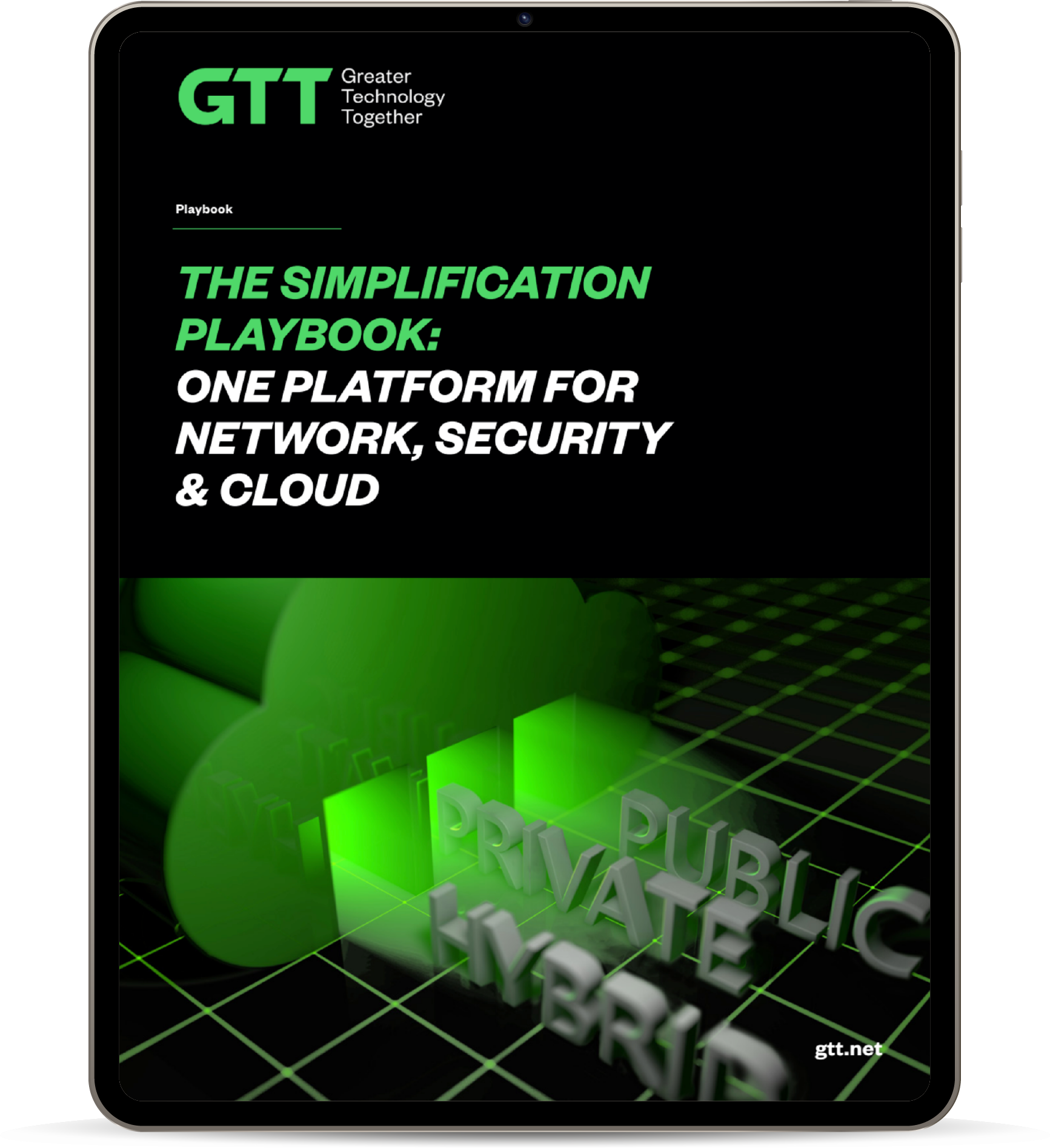
The Simplification Playbook: One Platform for Network, Security and Cloud
-
Learn more: AI Agents Are Here. Is Your Infrastructure Ready?

AI Agents Are Here. Is Your Infrastructure Ready?
-
Learn more: The New Rules of Hybrid Cloud: AI Workloads Demand a New Cloud Architecture

The New Rules of Hybrid Cloud: AI Workloads Demand a New Cloud Architecture
Subscribe to the GTT Insider
Get the latest news, articles and resources about our
products and services.